It sounds wild, but research from Oxford University shows that diners subconsciously rate food as higher quality and are willing to pay up to 15% more for it simply because it’s eaten with heavy, metallic cutlery. The brain transfers the “weight” of the tool to the value of the meal.
This is gastrophysics, the science of how our senses work together to create flavor. And for us at FIRST, it’s the secret weapon for moving F&B from a line item to a headline act. In this article, we’re exploring how brands are using this science to turn dinner into a story, starting with a rumor we heard from the beach.
1. The “Temporal” Strategy: Marriott’s Edible Sunset
Our team recently came back from an event, raving about a concept they heard was being piloted at a beachfront resort. The core idea was unforgettable: a “Sunset Dinner” where the menu wasn’t just paired with wine, but with the sky.
The Concept:
As the sun dips below the horizon, the courses shift to match the changing light.
- Golden Hour: As the sky turns yellow, guests begin with bright, acidic appetizers (think citrus-cured seafood or golden beets) that mirror the high-energy light.
- The Descent: As the sun sinks and the sky burns orange and red, the main courses arrive—rich, savory flavors and warm spices that match the visual intensity of the setting sun.
- Blue Hour: Finally, as the sky turns deep indigo, the meal concludes with cooling, soothing desserts designed to signal the brain that it’s time to rest.
Why it Works:
This taps into Sensation Transference. Our brains crave harmony. By aligning the “visual flavor” of the environment with the food’s actual flavor, the experience feels more immersive and “right.” It turns a standard dinner service into a fleeting, non-replicable performance that relies entirely on the specific time and place of the event (source).
2. The “Intellectual” Strategy: Chase Sapphire’s Edible Library
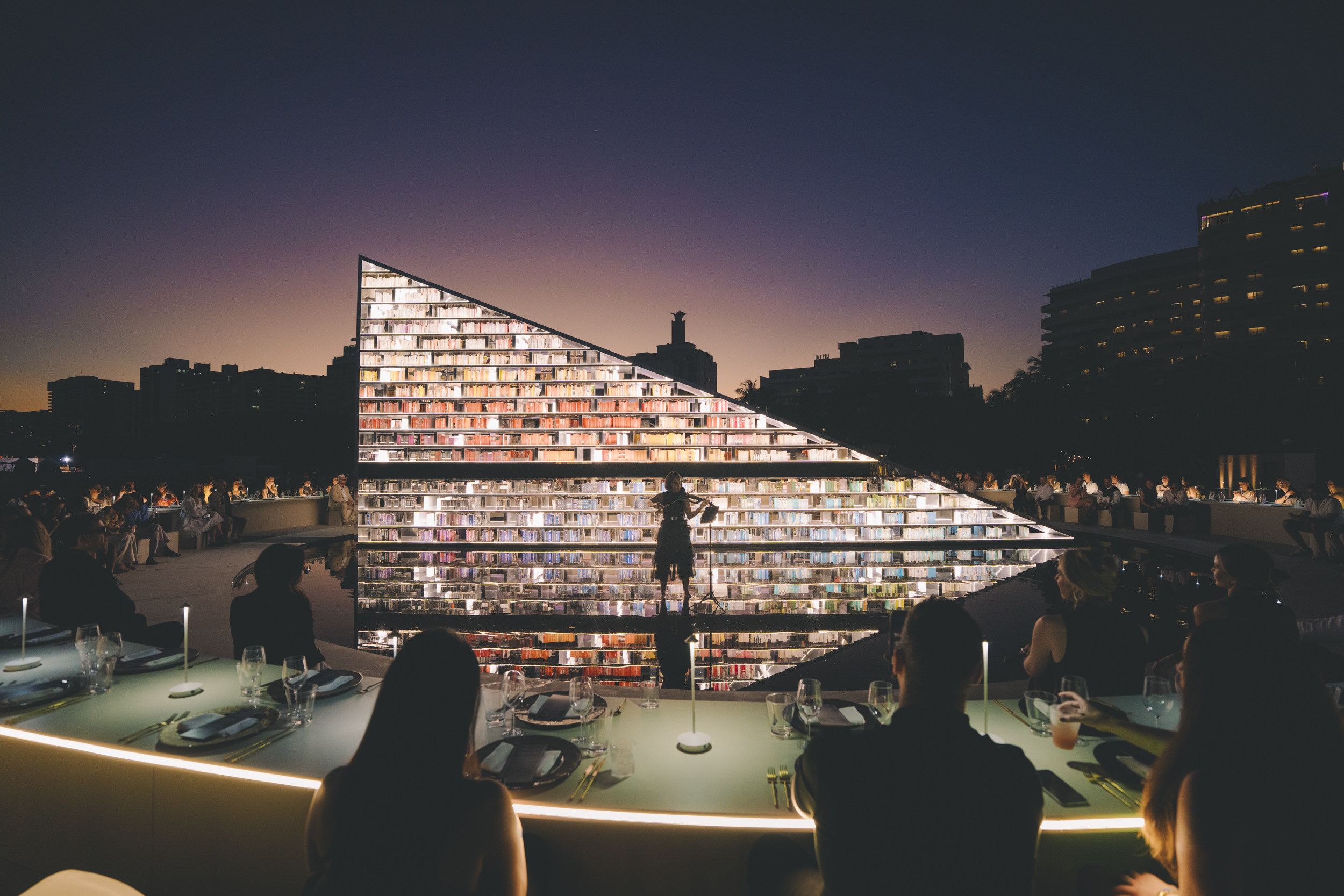
Chase Sapphire Reserve leveraged culture. During Miami Art Week, they partnered with artist Es Devlin to turn dinner into a “live literary performance” (source).
The Concept
The centerpiece was “The Library of Us,” a 50-foot rotating bookshelf on the beach. But the real magic was the Edible Library Dinner. Each course was a literal translation of a literary quote. Guests didn’t just read the words; they ate them. Furthermore, the table “revolved” between courses, forcing a social refresh where attendees met new people with every new chapter of the meal.The Science
This activates the Peak-End Rule, a psychological heuristic that leads people to judge an experience based on its most intense moment (the Peak) (source). By combining high-concept art with the primal act of eating, Chase created a “Peak” moment of awe that anchored the brand to a feeling of cultural sophistication.
3. The “Dopamine” Strategy: The Cheez-In Diner
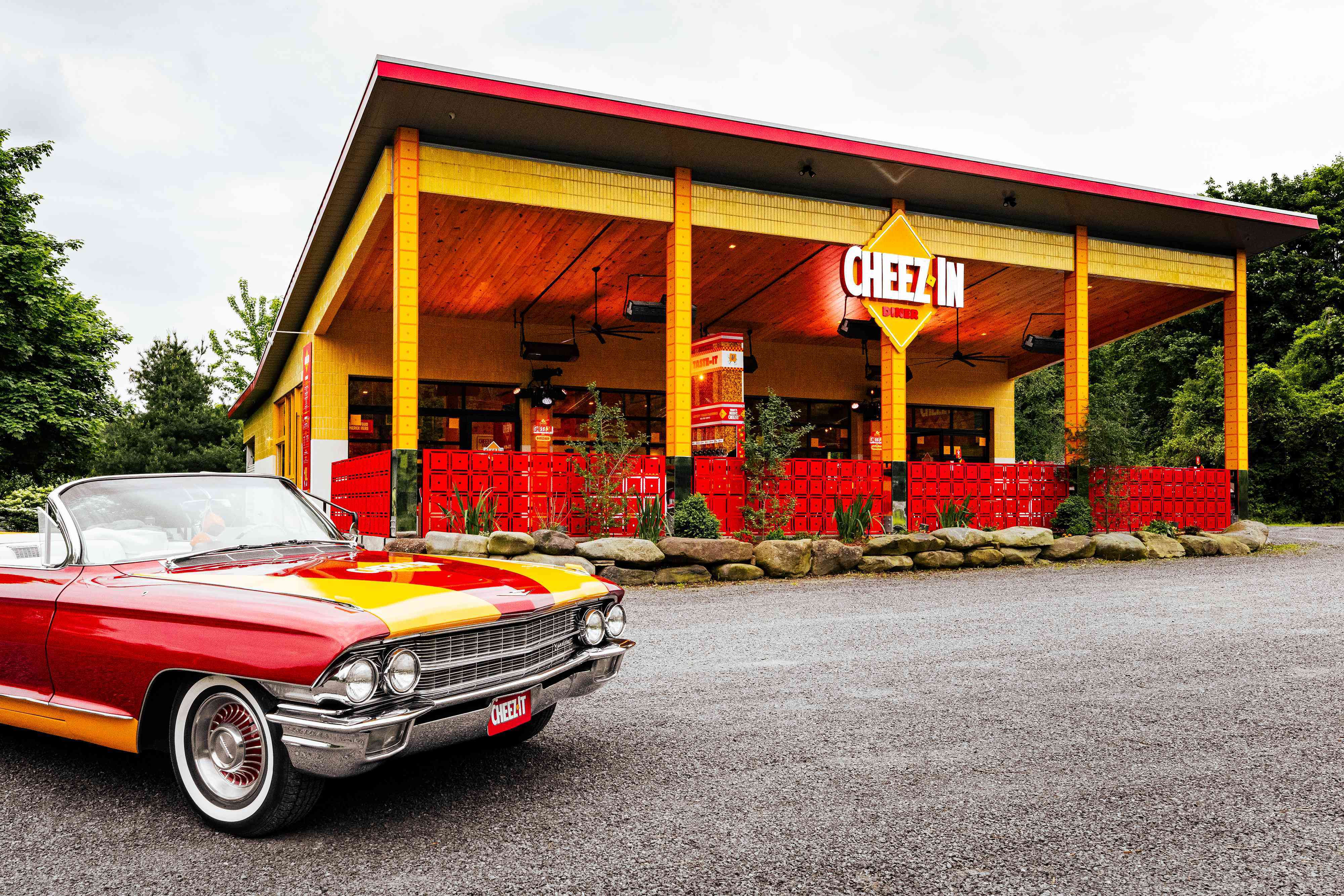
On the opposite end of the spectrum is the Cheez-In Diner, a roadside attraction in Woodstock that proved you don’t need foie gras to create a waiting list. You just need “Absurdist Hospitality.”
The Concept:
Cheez-It transformed a retro diner into a “total artwork” of snacking. The menu featured “Cheez-It Milkshakes” (vanilla blended with crackers) and a jukebox that played cracker crunch sounds. It was silly, it was orange, and people waited over three hours to get in (source)!
The Science:
This taps into the “Whimsy” trend dominating 2026, which highlights the introduction of elements of joy and surprise to combat global anxiety (source). The sheer absurdity of the food serves as a pattern interrupt, triggering a dopamine hit that makes the content highly shareable. Data shows that edible art installations like this are 4.6x more likely to be shared on social media rather than standard brand displays (source).
The FIRST Take: 4 Ways to Hack Your Next Event Menu
You don’t need a Florida sunset or a 50-foot bookshelf to apply these principles. Moving through 2026, here are four strategic tweaks that can have a huge impact on your next event:
- Sonic Seasoning: Don’t just pick a playlist for “vibes.” Science shows that high-pitched, tinkling sounds (like piano or wind chime sounds) can make food taste 10% sweeter, while low-pitched brass sounds can accentuate bitterness. Use this to balance your menu without adding sugar (source).
- The Weight of Worth: Remember the Oxford study. If you want your VIP dinner to feel “premium,” allocate your budget to high-quality cutlery and glassware. Flimsy disposables signal to the brain that the content of the event is “disposable,” too.
- Design for GLP-1 Era: We are seeing a massive dietary shift right now. Roughly 40 million Americans have type 2 diabetes, and an estimated 12% of adults are actively taking GLP-1 weight-loss medications (with another 30-35% interested). Because these drugs drastically reduce appetite, health-conscious eating is surging, leading to sharp volume declines in confections (-9%) and sugary drinks (-7%). Menus in 2026 must pivot away from carb-heavy buffets toward nutrient-dense, high-protein micro-portions (source).
- The $830 “Sober-Curious” Shift: Alcohol spending isn’t just dipping–it’s restructuring. Recent data shows that US alcohol consumption has fallen to 54%, its lowest point in nearly 90 years. This generational shift has wiped out over $830 billion in market capitalization for global liquor brands over the last four years. The demand for premium mocktails and non-alcoholic beer is officially mainstream. Treat your Zero-Proof menu with the same craft as your cocktails. Using complex, bitter, and botanical ingredients (like Lion’s Mane or ginger) mimics the “burn” of alcohol, releasing endorphins without intoxication (source)(source).
The Bottom Line
In an increasingly digital world, food remains our last truly analog frontier. It is the only medium that commands our full, multisensory attention. For brand marketers, the opportunity lies not in simply feeding the guest, but in designing a sensory narrative that lingers long after the plate is cleared.
Engage with FIRST